What Are Hall Effect Switches? A Beginner's Guide to Magnetic Keyboard Technology
A gaming keyboard may look much like a traditional mechanical model, but the technology underneath the keycaps can make a significant difference in how it responds.
Hall Effect switches are a good example. Instead of relying on physical electrical contacts to register a keystroke, they use magnetic field detection to track key movement. This approach makes features such as adjustable actuation and Rapid Trigger possible on compatible keyboards.
For gamers, especially those who play competitive FPS titles, these features offer more flexibility when controlling movement and repeated inputs. But Hall Effect technology is not just about gaming performance. It also changes how users can customize their keyboard's response.
So, what are Hall Effect switches, how do magnetic keyboard switches work, and what makes them different from traditional mechanical switches? Let's break down the technology and look at what it means in everyday use.
1. What Are Hall Effect Switches?
Hall Effect switches are a type of magnetic keyboard switch that detects key movement through changes in a magnetic field.
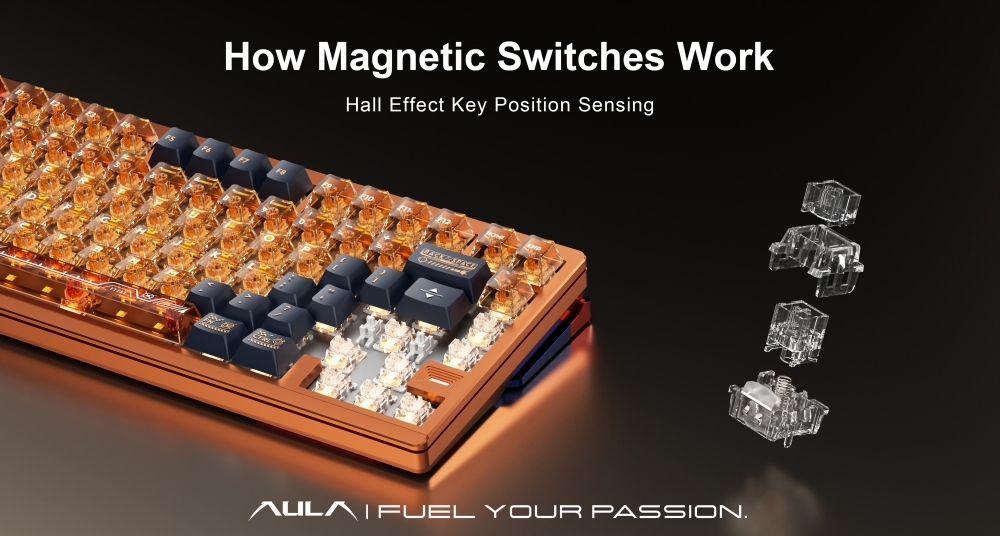
A typical Hall Effect switch contains a magnet inside the moving switch stem and a Hall Effect sensor positioned on the keyboard's PCB. When a key is pressed, the magnet moves relative to the sensor, changing the magnetic field that the sensor detects.
The keyboard's controller then processes this information to determine the key's position and whether it has reached the configured actuation point.
The main difference between Hall Effect switches and conventional mechanical switches is how they register input. Traditional mechanical switches generally use physical electrical contacts, while Hall Effect switches rely on contactless magnetic sensing.
Because the system can track key travel rather than depending on one fixed electrical contact point, compatible Hall Effect keyboards can offer more control over actuation distance and reset behavior. This is what makes magnetic keyboard technology particularly interesting for users who want to customize how their keys respond.
2. How Do Magnetic Keyboard Switches Work?
Understanding how Hall Effect switches work is easier when you look at the components involved. A typical system relies on three main parts:
Magnet: Moves along with the switch stem when a key is pressed or released.
Hall Effect Sensor: Detects changes in the magnetic field as the magnet moves.
Keyboard Controller: Processes the sensor data and determines when an input should be registered.
Here's how the process works during a keystroke.
Step 1: The key moves downward
When you press a key, the switch stem travels downward and carries the built-in magnet with it.
Step 2: The magnetic field changes
As the distance between the magnet and the Hall Effect sensor changes, the magnetic field detected by the sensor also changes.
Step 3: The sensor measures key movement
The sensor converts magnetic field variations into electrical signals. The keyboard controller uses this information to determine the key's position.
Step 4: The keyboard registers the input
Once the key reaches its configured actuation point, the keyboard sends the corresponding input to the computer.
Unlike a traditional switch that relies on physical contact to complete an electrical circuit, a Hall Effect switch can provide continuous position information within its operating range.
This position-based detection is the foundation for features such as adjustable actuation, dynamic reset, and Rapid Trigger.
3. What Makes Hall Effect Keyboards Different?
The biggest advantage of Hall Effect keyboard technology is not simply the use of magnets. It's the additional control that position-based input detection can provide. Three features are particularly worth understanding.
Adjustable Actuation: Set Your Preferred Key Response
On a conventional mechanical keyboard, the actuation point is generally determined by the switch's physical design.
A Hall Effect keyboard with adjustable actuation works differently. Users can change how far a key needs to travel before the keyboard registers an input.
For example, a gamer might prefer a shallow actuation setting for frequently used movement keys, allowing them to trigger inputs with less key travel. For general typing, a deeper setting may help reduce accidental presses.
Some keyboards also support individual key adjustments, making it possible to configure different response settings for different keys.
This flexibility is useful for people who want their keyboard to match their playing habits rather than adapt their habits to a fixed switch design.
Rapid Trigger: A Different Approach to Key Reset
Rapid Trigger is one of the most discussed features in modern Hall Effect gaming keyboards.
With a conventional mechanical switch, the key usually needs to return to a predetermined reset position before another input can be registered.
Rapid Trigger changes this behavior. On supported keyboards, the reset point can respond dynamically to the key's movement. As soon as the key begins moving upward by the configured amount, the keyboard can reset the input. Pressing it down again can then register another input.
This reduces the amount of key travel needed between repeated presses.
For competitive FPS players, this can be useful when making quick directional adjustments or performing movement techniques that involve frequent changes between opposing keys.
However, Rapid Trigger performance depends on more than the switch itself. Sensor resolution, keyboard firmware, scanning frequency, and software implementation all influence the actual experience.
Customizable Key Response: More Control Over Individual Keys
Many Hall Effect keyboards include dedicated software for adjusting input behavior.
Depending on the model, users may be able to configure:
Individual key actuation points
Rapid Trigger sensitivity
Key reset behavior
Different input profiles for specific games
Other advanced keyboard functions
Not every model offers the same level of customization, so it's worth checking the software features before choosing a keyboard.
4. Hall Effect vs. Mechanical Keyboard Switches: Which Is Different?
Both Hall Effect and traditional mechanical switches can deliver a satisfying typing experience. The difference mainly comes down to how they detect key movement and the level of input customization they support.
Feature | Traditional Mechanical Switches | Hall Effect Switches |
Detection method | Physical electrical contacts | Magnetic field sensing |
Actuation point | Usually determined by switch design | Adjustable on compatible models |
Rapid Trigger | Generally not a standard feature | Available on supported models |
Key response customization | Depends on keyboard and software | Often offers more position-based control |
Typing feel | Depends on switch construction | Also depends on switch construction |
Sound profile | Depends on switches and keyboard structure | Also depends on switches and keyboard structure |
One thing worth clarifying is that Hall Effect technology does not automatically make a keyboard quieter, smoother, or more comfortable. Typing feel is influenced by several physical factors, including spring weight, stem design, switch housing, lubrication, stabilizers, and mounting structure. The keyboard's plate, keycaps, and internal sound-dampening materials also contribute to the overall experience. Traditional mechanical switches remain a practical choice for users who enjoy different switch types and established typing characteristics. Hall Effect switches are more appealing to those who prioritize adjustable input behavior and advanced gaming functions. The better option ultimately depends on what you expect from your keyboard.
5. Are Hall Effect Switches Good for Gaming?
Hall Effect switches have attracted considerable attention in the gaming community because they offer more control over key actuation and reset behavior.
Their benefits are particularly noticeable in games where repeated inputs and precise movement matter.
Competitive FPS Games
In competitive first-person shooters, players often need to make quick directional changes while maintaining precise movement control.
Rapid Trigger can help reduce the key travel required between repeated inputs. This is especially relevant for players who frequently alternate between movement keys during strafing and counter-strafing.
A customizable actuation point also allows players to adjust frequently used keys according to their preferences.
Rhythm and Timing-Based Games
Rhythm games often involve repeated key presses that need to match specific timing patterns.
Adjustable actuation and dynamic reset can give players more flexibility when configuring their keyboard for rapid input sequences. The actual benefit depends on the game's mechanics and the player's preferred settings.
Everyday Gaming and Typing
Hall Effect keyboards are not exclusively designed for competitive gaming.
They can also be used for everyday gaming, office tasks, and general typing. Some users prefer a more sensitive response for gaming while choosing a deeper actuation setting for regular typing.
The important thing is to avoid setting every key too sensitively. An actuation point that works well in one game may lead to unwanted inputs when typing.
6. What Should You Consider Before Buying a Hall Effect Keyboard?
Understanding the technology is only part of choosing the right keyboard. Different Hall Effect keyboards can vary considerably in their hardware, software, and overall construction.
Here are several factors worth checking before making a decision.
Actuation Adjustment Range: Check how much adjustment the keyboard supports and whether individual keys can be configured separately.
Rapid Trigger Support: Confirm that the keyboard actually includes Rapid Trigger rather than assuming every magnetic switch model offers it.
Software Compatibility: Look at whether the software provides clear controls for actuation, reset sensitivity, and gaming profiles.
Polling Rate and Input Performance: A higher polling rate can increase how frequently the keyboard reports information to the computer, but it is only one part of overall input performance.
Build Quality and Typing Experience: Consider the keyboard layout, case material, stabilizers, keycaps, mounting structure, and sound profile. These factors remain important regardless of switch technology. A well-designed Hall Effect keyboard should balance magnetic input technology with practical usability.
7. Explore AULA Hall Effect Keyboards
At AULA, the development of Hall Effect keyboards focuses on combining magnetic input technology with thoughtful keyboard design. Different models offer different approaches to layout, construction, and performance, giving users more options when exploring magnetic keyboard technology.
AULA F75 HE: Familiar 75% Layout with Magnetic Input
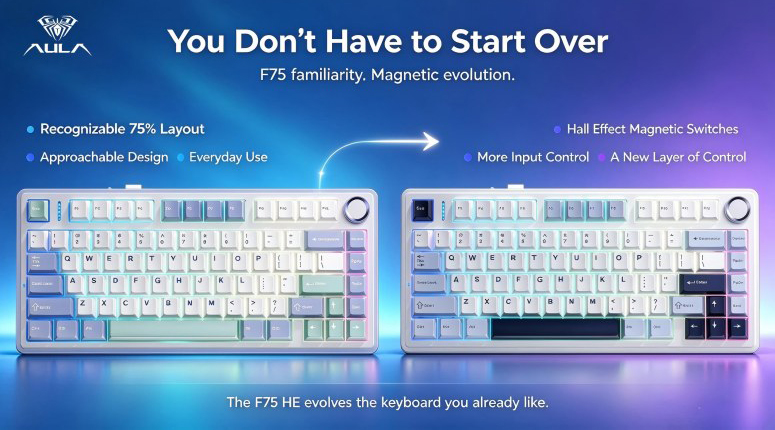
The AULA F75 HE brings Hall Effect technology into the familiar 75% keyboard layout.
For users who appreciate the compact arrangement of a 75% keyboard, it combines a practical form factor with magnetic switch features, adjustable actuation, Rapid Trigger, and an 8K wired polling rate.
Its design makes it an option for gamers who want to move from a conventional mechanical keyboard to a magnetic keyboard without giving up the convenience of a familiar layout.
AULA HERO75 HE: Magnetic Performance with a Distinctive Design
The AULA HERO75 HE combines magnetic switch technology with a four-season color concept.
Its compact 75% layout brings together gaming-oriented input customization and a more expressive visual design. This gives users an alternative to keyboards that focus primarily on a conventional gaming aesthetic. For those who want adjustable magnetic input features alongside a distinctive appearance, the HERO75 HE offers a different approach to the Hall Effect keyboard experience.
AULA AG75: A More Premium Magnetic Keyboard Design
The AULA AG75 takes a more premium approach to magnetic keyboard construction. Its CNC-machined aluminum body provides a more substantial exterior, while its three-chip architecture supports the keyboard's advanced input system. The model also features 0.001 mm Rapid Trigger adjustment, giving users more granular control over key response settings. For users who pay attention to both internal keyboard technology and external construction, the AG75 brings these elements together in one magnetic keyboard design. Each model has its own design priorities, but they share the same direction: making advanced magnetic input technology more accessible to different types of gaming keyboard users.
8. Frequently Asked Questions About Hall Effect Switches
Are Hall Effect switches better than mechanical switches?
Neither technology is universally better. Hall Effect switches offer adjustable actuation and Rapid Trigger on compatible keyboards, while traditional mechanical switches provide a wide selection of typing feels and switch characteristics. The right choice depends on your usage habits.
Can Hall Effect switches be customized?
Yes. Many Hall Effect keyboards support software-based customization, including adjustable actuation points and Rapid Trigger sensitivity. The available settings vary by model.
Are Hall Effect keyboards good for typing?
Yes. Hall Effect keyboards work for everyday typing, office tasks, and gaming. Users can adjust the actuation point to suit their preferences, although extremely sensitive settings may increase accidental inputs during regular typing.
Do all Hall Effect switches support Rapid Trigger?
No. Hall Effect technology makes dynamic reset possible, but Rapid Trigger still requires compatible keyboard hardware, firmware, and software. Always check the specifications of the specific model.
Do Hall Effect switches sound different from mechanical switches?
The magnetic sensing method does not determine the sound of a keyboard. Switch housing, spring design, keycaps, stabilizers, plate material, mounting structure, and internal dampening have a much greater influence on the final sound profile.
Are Hall Effect keyboards worth buying?
They can be a worthwhile option if you want adjustable actuation, Rapid Trigger, and more control over key response. However, if your main priority is everyday typing rather than advanced gaming input, a traditional mechanical keyboard may already meet your requirements.
Final Thoughts: Is Magnetic Keyboard Technology Worth Exploring?
Hall Effect switches represent a different approach to keyboard input. By using magnetic field detection to track key movement, they make adjustable actuation and dynamic reset features possible on compatible keyboards.
For competitive gamers, especially those who rely on frequent directional changes and repeated inputs, these features provide additional ways to customize keyboard response. For everyday users, they offer another option when choosing a keyboard that matches their typing habits.
Still, switch technology is only one part of the overall experience. Layout, typing feel, sound, build materials, and software usability all deserve attention when comparing different models.
If you're exploring magnetic keyboard technology, understanding how Hall Effect switches work is a good starting point.
AULA — Fuel Your Passion.